Introduction
Flashcards work because of two specific, well-studied mechanisms — not because they're a familiar habit. Forcing yourself to retrieve an answer from memory (rather than re-reading it) and spacing that retrieval out over days instead of cramming it into one session are two of the highest-value study techniques identified in a major review of the learning-science research (Dunlosky et al., "Improving Students' Learning With Effective Learning Techniques," Psychological Science in the Public Interest). Making your own cards adds a third benefit: the act of deciding what belongs on the card is itself a round of processing the material. Here's how to build a set that actually holds up to that research, not just a stack of index cards.
1. Benefits of DIY Flashcards
Store-bought flashcard sets are convenient, but making your own has real, specific advantages beyond cost:
- Customization: A commercial multiplication-facts deck can't know that your child specifically mixes up 7×8 and 7×9 — a homemade card can isolate exactly that pair for extra reps.
- Engagement: Writing the card is a first retrieval attempt. A student who copies "photosynthesis: the process plants use to convert light into energy" from the textbook onto a card has already reviewed it once before the first study session even starts.
- Cost-Effective: A 100-count pack of 3x5 index cards costs a few dollars and makes several full subject decks — no subscription or per-set purchase needed.
- Flexibility: The same blank-card format works for a kindergartner's sight words and a high schooler's AP Biology terms — only the content changes.
2. Materials Needed for DIY Flashcards
You need less than it looks like. A basic, effective set requires:
- Index cards (3x5" for single words or short facts; 4x6" if a card needs a full sentence or a diagram)
- A pen for text and a couple of highlighters or colored pencils — reserve full marker sets for younger kids who benefit from bigger, bolder visuals
- A hole punch and a binder ring, or a rubber band — this alone makes cards far less likely to get lost or shuffled out of order
- Clear packing tape for lamination-on-a-budget — covering both sides protects against the bent corners and smudged pencil that make cards unreadable within a week
- Optional: a cheap set of colored index cards (not just colored pens) — color-coding by subject or difficulty level at the card level, not the ink level, makes sorting by feel possible even without reading the card
3. Creative Design Ideas
Design choices should serve recall, not just decoration — but a few specific techniques do both:
- Color by Category, Not Randomly: All verb-conjugation cards on blue cards, all vocabulary on yellow — a student flipping through a mixed deck can sort by color before even reading, which speeds up targeted review sessions.
- One Small Image, Not a Full Illustration: A quick stick-figure drawing of a "convex" lens curving outward takes ten seconds and anchors the term better than the word alone — elaborate art takes time away from making more cards.
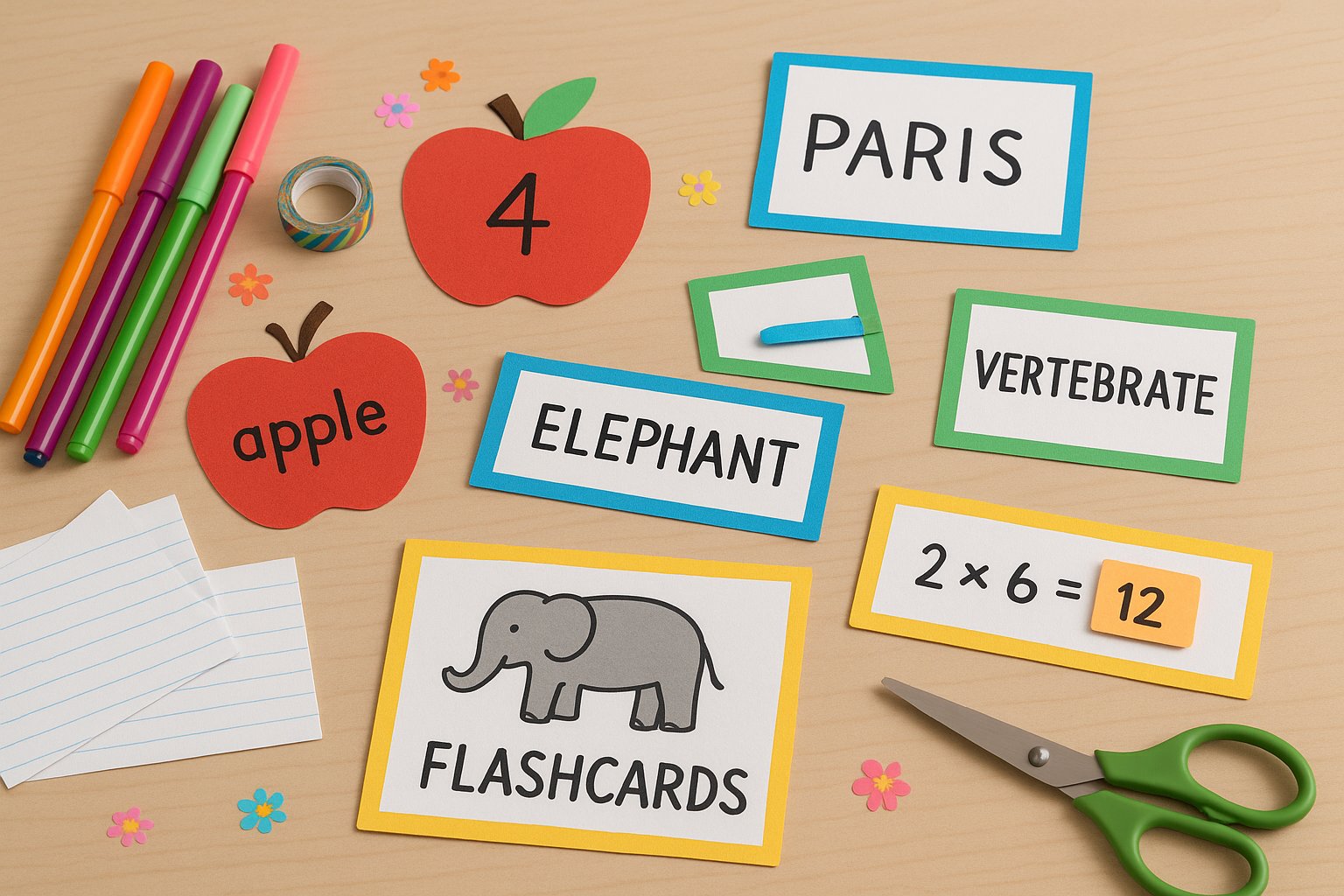
- Fold-Down Answer Flaps: Fold a strip of paper over the answer and tape only the top edge, so the question stays visible while the answer stays hidden until lifted — useful for cards with multi-part answers.
- Cut-to-Shape for Early Readers: For pre-K/K sight words specifically, cutting a card into a simple shape tied to the word ("stop" cut into an octagon) gives an extra non-text cue that fades out naturally as reading skill improves.
4. Best Practices for Effective Flashcards
These four practices are where the actual research evidence lives — get these right and the crafting details above matter far less:
- One Fact Per Card: A card that asks "What are the causes and effects of the French Revolution?" is really five or six facts crammed together. Split it into separate cards — it feels slower to make but produces much more reliable recall.
- Active Recall, Every Time: Say the answer out loud (or write it down) before flipping the card — silently reading the front and immediately flipping to check skips the retrieval step that makes flashcards work at all. Practice testing was rated a high-utility technique across ages and subjects in the Dunlosky review cited above, specifically because it forces this kind of retrieval.
- Spaced Review, Not One Long Session: Reviewing a deck once a day for five days beats reviewing it five times in one sitting — the same review, spread across days, produces better retention because a bit of forgetting between sessions is what makes the next retrieval effortful (and effective). This "spacing effect" is one of the seven core recommendations in the Institute of Education Sciences' practice guide on organizing study for better retention (IES, Organizing Instruction and Study to Improve Student Learning).
- Sort Into a "Know It" and "Still Learning" Pile: Don't review a mastered card as often as a shaky one. Physically split the deck each session — cards moved to "know it" get revisited every few days, "still learning" cards get reviewed daily until they graduate.
5. Subject-Specific Flashcard Applications
The same card format needs different content strategies depending on the subject:
- Language Arts: For vocabulary, put the word on the front and a student-written example sentence (not just a dictionary definition) on the back — generating your own sentence is a stronger memory cue than copying one.
- Mathematics: For multiplication facts, put only the ones a student consistently misses on cards — reviewing the full 1-12 table every session wastes time on facts that are already automatic.
- Science: For process-based content (the water cycle, cell division), use one card per step with a small diagram, then physically lay the cards in order as a sequencing check, not just an isolated recall check.
- Social Studies: For historical dates, pair the date with a one-line "why it mattered" on the same card — a bare date ("1215") is nearly impossible to recall without the context that makes it meaningful (Magna Carta, limits on royal power).
6. Incorporating Technology
Digital tools solve one real limitation of paper cards: they can track what you've missed and automatically resurface it. Free, well-established options include:
- Spaced-repetition apps like Anki: Anki (free, open-source) uses an algorithm that automatically increases the interval between reviews for cards you get right and shortens it for ones you miss — automating the "still learning" pile from section 4 above.
- Quizlet or similar study-set tools: Useful for quickly digitizing a paper deck to review on a phone during downtime, and for built-in game modes that add retrieval practice without extra prep work.
- QR codes on physical cards: For a hybrid approach, a small printed QR code linking to a short explainer video works well for concepts (a science process, a grammar rule) that benefit from a visual walkthrough beyond what fits on a card.
7. Engaging Flashcard Activities
These formats keep retrieval practice from feeling repetitive, which matters most for younger or reluctant learners:
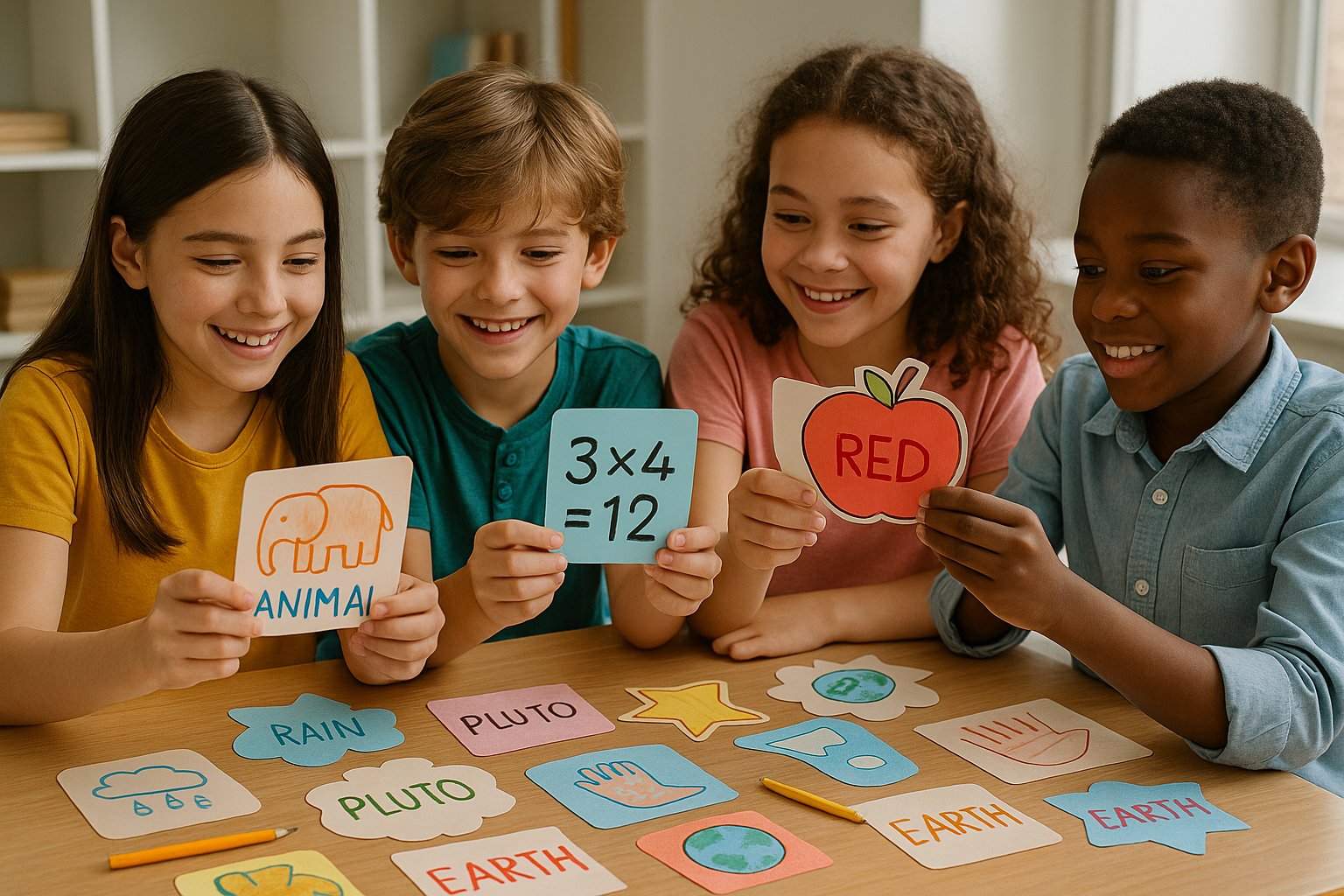
- Memory Match: Make two cards per fact — one with the term, one with the definition — lay them face-down, and match pairs. This works retrieval from both directions instead of only term-to-definition.
- Flashcard Relay: Tape cards around a room or yard; the student runs to a card, answers it out loud, and only proceeds to the next if correct — useful for kids who need movement built into study time.
- Beat the Clock: Time how many cards a student can correctly answer in 60 seconds, then try to beat that number in a later session — this turns spaced review into a game with visible progress instead of a chore.
8. Organizing and Storing Flashcards
An unsorted shoebox of cards is the single biggest reason DIY flashcard systems get abandoned. A simple fix:
- The Leitner Box Method: Use three small boxes or envelopes labeled "daily," "every few days," and "weekly." New and missed cards go in "daily"; cards you get right move up a box, and any card you miss drops back to "daily" — this builds spaced repetition into physical storage without needing an app.
- Label by Subject and Date Made: A small date in the corner of each card lets you spot which cards have been in rotation the longest and are overdue for retirement once mastered.
- Binder Rings Over Loose Stacks: A binder ring through a hole-punched corner keeps a subject deck intact in a backpack — loose cards in a folder scatter within a week.
FAQs
Q1: How can I make flashcards more durable?
A1: Clear packing tape over both sides of a card is a cheap, effective substitute for a laminator and holds up well to a backpack. For cards in heavy daily rotation, cardstock instead of standard index cards resists bending better from the start.
Q2: What is the ideal size for a flashcard?
A2: 3x5" works for single words, dates, or short facts. Move up to 4x6" only when a card genuinely needs a full sentence, a diagram, or multiple steps — bigger cards that are mostly blank space just slow down flipping through a deck.
Q3: How many flashcards should I review in one session?
A3: 20-30 cards keeps a session focused without fatigue setting in. For larger decks, split by the Leitner box method above rather than trying to push through 100 cards in one sitting.
Q4: Can flashcards be used for group study?
A4: Yes — one person holds the card and asks, the other answers before seeing it, then they switch. This preserves the active-recall step that makes flashcards effective; simply reading cards aloud together does not.
Q5: How often should flashcards be reviewed?
A5: Daily for new or frequently-missed cards, tapering to every few days and then weekly as a card moves from "still learning" to "know it." The exact interval matters less than the fact that it increases over time rather than staying fixed.
Q6: Are there digital alternatives to physical flashcards?
A6: Yes — apps like Anki and Quizlet handle the spacing calculation automatically, which is useful for older students managing large decks, though younger kids often benefit more from the physical act of writing and holding paper cards.
Conclusion
The materials and decorations matter far less than two things: making sure every card forces real retrieval (say the answer before you flip it) and reviewing on a spaced schedule instead of cramming. Everything else in this guide — colors, shapes, storage boxes, apps — exists to make those two habits easier to stick with.