
Introduction
Long before a child sounds out their first word, the groundwork for reading is already being laid — in the back-and-forth of a conversation at the dinner table, the cereal box a toddler recognizes by shape and color, the rhyme a preschool teacher claps out during circle time. Early childhood (birth through about age eight) is when the brain is most efficient at picking up language and sound patterns, which is exactly why the quality of a child's early environment — at home and in preschool or kindergarten classrooms — has an outsized effect on how easily reading clicks later on. This article breaks down what actually moves the needle in those years, with specific things a parent or teacher can try this week rather than another list of things "research shows matter."
Oral language: the foundation long before decoding starts
Children don't learn to talk by being talked at — they learn by being talked with. A useful, research-backed technique for turning any picture book into a language-building conversation is the PEER sequence used in dialogic reading: Prompt the child to say something about the page ("What's happening here?"), Evaluate their response, Expand on it by adding a detail or new word, then Repeat the prompt so the new language sticks. So instead of just reading "The dog ran to the truck," a parent might stop and ask what the dog is doing, respond "Yes, he's running!", expand with "He's running fast to the fire truck," then ask the child to say it back. Research on dialogic reading has found children read to this way move ahead of peers read to traditionally on language measures within just a few weeks — and the effect holds across homes, preschools, and income levels (Reading Rockets).
Vocabulary grows fastest when new words are tied to something a child can see, touch, or do — which is why a walk to the mailbox ("Let's see if the mail carrier left anything in the mailbox") or a cooking session ("we need to whisk the eggs, not stir them") often teaches more usable vocabulary than a flashcard ever will. The goal isn't a bigger word list for its own sake; it's giving children enough language in their ears that the words they'll later meet in print are already familiar when they get there.
Try this at home or in the classroom:
- Use the PEER sequence during at least one read-aloud a day — it takes the same amount of time as reading straight through, just with pauses
- Narrate everyday routines out loud ("I'm folding the towel in half, then in half again") instead of doing them silently
- Sing rhymes and clapping chants (like "Down by the Banks") — the repeated sound patterns build the same sound-awareness skills phonics instruction will later depend on
Phonemic awareness: the single skill that predicts the most
Phonemic awareness — hearing and manipulating the individual sounds in words, separate from the letters that represent them — is one of the two strongest school-entry predictors (along with letter knowledge) of how well a child will learn to read in the first two years of instruction (Reading Rockets). It's also entirely oral — a child can build phonemic awareness with their eyes closed, no letters or print required.
A concrete way to practice it: say a word slowly in its separate sounds — "/c/ /a/ /t/" — and have the child blend them back together and say "cat." Or do it in reverse: say "sun" and ask the child to say just the first sound, then just the last sound. Clapping out syllables in a child's own name ("Ma-ri-a," three claps) is another low-prep way to build the same muscle before school even starts. Games built around isolating, blending, and swapping sounds — the kind found on the ABZ Learning games library — give kids repeated, low-stakes practice at exactly this skill.
Print awareness and the read-aloud
Print awareness is the understanding that those squiggles on the page are language — that print runs left to right, that spaces mark word boundaries, that the same word "stop" on a stop sign says the same thing every time. This is often a child's very first bridge into reading, and it can be built almost entirely through pointing things out during everyday moments: running a finger under the words while reading a bedtime story, letting a child "read" a cereal box or a familiar restaurant logo, labeling classroom shelves so children see their own reading catching up to the print around them (Reading Rockets).
Read-alouds do double duty here: alongside vocabulary and print awareness, they're where children first hear what fluent reading sounds like — where a sentence pauses, how a question is voiced differently than a statement — before they're ever asked to produce it themselves.
Play and emergent writing: practicing literacy without a worksheet
A child running a pretend grocery store, writing a "receipt" in scribbles, and telling a customer "that'll be five dollars" is doing real literacy work — using narrative structure, practicing that marks on paper carry meaning, and rehearsing vocabulary in context. Dramatic play corners stocked with clipboards, phone message pads, and "menus" turn imaginative play into low-pressure writing practice.
Emergent writing itself moves in a predictable arc: scribbles that stand for words, to strings of random letters, to a child's own name spelled correctly, to inventive spelling ("I wnt to the zoo"). The most useful thing an adult can do at each stage is resist the urge to correct and instead ask the child to "read" what they wrote back to you — that's what tells them their marks carry meaning, which is the whole point of writing before spelling accuracy is. Journals, sign-making, and a dedicated "writing table" with real markers and paper (not just coloring sheets) give children a reason to keep practicing.
Supporting diverse learners
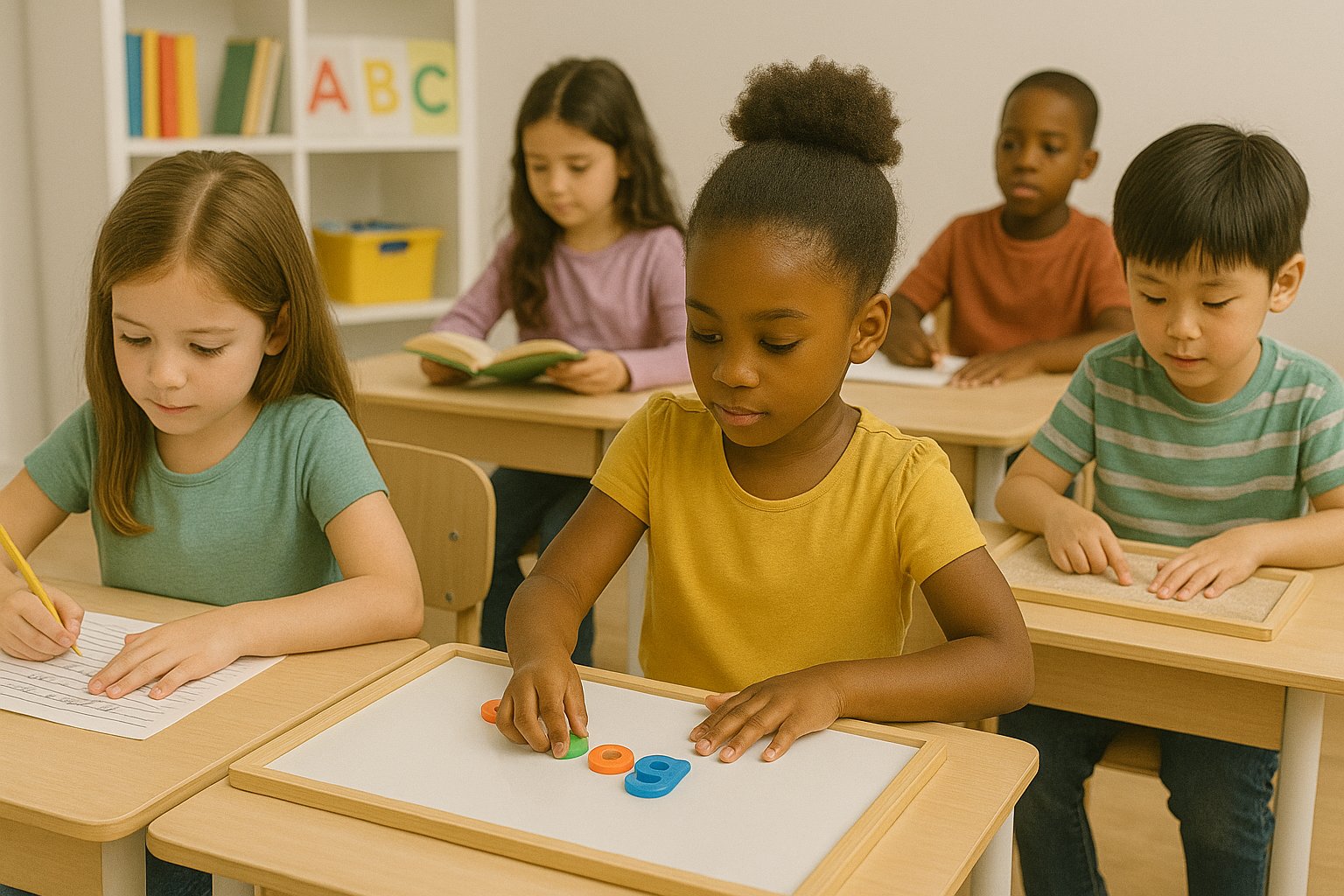
Not every child arrives at literacy instruction the same way. A child who speaks a language other than English at home is building phonemic awareness in two sound systems at once — which is an asset, not a deficit, but it means new vocabulary needs extra context (a picture, a gesture, a real object) to land. A child with a speech-sound delay may need phonemic awareness tasks broken into smaller steps — isolating just the first sound of a word before attempting a full blend. Multisensory approaches — tracing a letter in sand while saying its sound, using colored blocks to represent each sound in a word — give children more than one pathway to the same skill, which matters most for kids who don't pick concepts up from a single explanation alone.
Family engagement: what actually moves the needle at home
One of the most consistent findings in early literacy research is also the simplest: reading aloud to a child, regularly, is one of the highest-leverage things a family can do for language and literacy growth (Reading Rockets). It doesn't require a curriculum — a nightly ten-minute story, a weekly library visit, or letting a child "help" write the grocery list all count. What tends to make the difference isn't a special program; it's consistency and a small amount of back-and-forth talk layered on top of the reading, the same PEER-style prompting described above. Schools can support this without asking more of already-stretched families by sending books home instead of worksheets, and by keeping literacy nights genuinely low-pressure — modeling one read-aloud technique rather than presenting a list of things parents "should" be doing.
What teacher preparation and assessment actually change
Programs succeed or fail on how well teachers are trained to deliver them. The Institute of Education Sciences' practice guide on foundational reading skills for K-3 rates direct, explicit instruction in phonemic awareness and word decoding as backed by strong evidence — its highest evidence tier — while noting that simply exposing children to language-rich environments without explicit sound-and-letter instruction is not enough on its own (Institute of Education Sciences). In practice, that means teacher training matters most when it goes beyond "read to your class often" and covers how to explicitly teach and check specific sound-symbol skills.
Ongoing progress monitoring is how teachers know whether that instruction is landing for an individual child rather than the class average. This doesn't need to be formal testing — a quick running record, a checklist of which letter sounds a child can produce on request, or noting which words a child stumbles on during a shared read tells a teacher (or parent) whether to keep moving forward or circle back and reteach.
Common obstacles, and where technology actually helps
The biggest real-world barriers to strong early literacy are usually structural, not instructional: limited access to quality preschool, large class sizes that make individualized phonemic-awareness practice hard to fit in, and thin classroom book budgets. Technology doesn't solve those problems, but used well it can stretch a teacher's or parent's time — a phonics game that gives a child ten extra minutes of blending practice a day is doing something a worksheet packet usually can't, which is adapting difficulty and giving immediate feedback. The caution: digital tools work best as a supplement to explicit instruction and read-aloud time, not a replacement for the adult interaction described above — a screen can't run the PEER sequence.
Why social-emotional safety matters for literacy risk-taking
Sounding out a new word wrong in front of the class, or reading aloud when you're not confident yet, is a genuine social risk for a five-year-old. Children who feel safe making mistakes — because a teacher responds to a wrong guess with "good try, let's look at that again" rather than correction alone — take more of the small risks that reading requires. This is less about a formal SEL curriculum and more about the everyday tone an adult sets around getting things wrong while learning to read.
Conclusion
None of this requires a specialized curriculum or a big budget. The through-line across oral language, phonemic awareness, print awareness, play, and family routines is the same: children build reading skill through repeated, low-pressure, language-rich interaction with adults — long before "reading instruction" formally begins. Early childhood education's job is to make sure every child gets enough of that interaction, regardless of what's happening at home, and to layer in explicit, evidence-based instruction in sound-symbol skills once the oral foundation is there.
FAQs
Q1: At what age should literacy instruction begin?
A1: Informal literacy-building — talking, singing, reading aloud — should start at birth. Formal, explicit instruction in letter sounds and blending typically begins around preschool age, roughly 3 to 5 years old.
Q2: What is the most important literacy skill for preschoolers?
A2: Phonemic awareness — hearing and manipulating individual sounds in words — is one of the strongest predictors of later reading success, alongside letter-name knowledge.
Q3: How can parents support literacy at home?
A3: Read aloud daily using the PEER technique (prompt, evaluate, expand, repeat), narrate everyday routines out loud, point out print in the environment, and let children "write" — even in scribbles — on their own terms.
Q4: Are digital tools effective in early literacy?
A4: They can be, as a supplement to explicit instruction and read-aloud time — not a replacement for them. Look for tools that give immediate, specific feedback on a targeted skill (like blending sounds) rather than open-ended screen time.
Q5: What if a child is not interested in reading?
A5: Follow their actual interests — a reluctant reader who loves trucks or dinosaurs will often engage with a nonfiction book on that topic long before they'll engage with an assigned story. Short, low-pressure sessions build more motivation than longer ones a child resists.